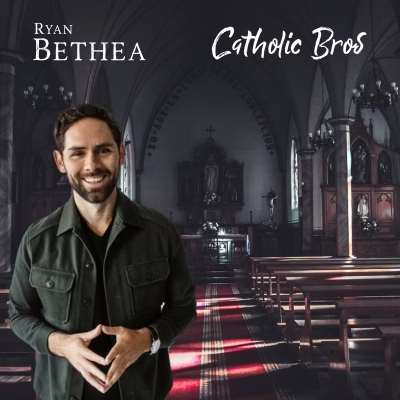
As with all great things, it came unexpectedly. A friend contacted me and said, you have to meet Ryan Bethea. Next thing I know, we’re on the phone discussing faith, football and digital ministry strategies. As I listened to Ryan and viewed his vast portfolio of Christian content, I couldn’t help but think – this man is uniquely talented. Here is someone with an ability to address sometimes thorny topics, but in an educational and engaging way.
First impression, I thought – he’s not a Catholic but he speaks as if he has been a Catholic for many years. In fact, more than most cradle Catholics I listen to. Who is this guy?
But here is the kicker that I think makes Ryan Bethea unique. There is a juxtaposition in his approach. Where there is darkness in play, he draws out the light. Where there is seriousness, he sprinkles in humor. Where there is division, he highlights common ground. Where there is a Protestant, there is a Catholic Priest.
Yes indeed, Ryan genuinely seeks THE TRUTH – the answers to big questions. In this way – he delivers.
I thoroughly enjoyed this interview and learning from Ryan. I hope you do too. ~Dan (@Catholic Bros)
Dan: Ryan, thank you so much for taking the time. As the Moses of The Exorcist Files, please tell us about the genesis of this popular top ranked Podcast.
Ryan: It’s a long story but, in short, I was researching miracles. I’ve always been fascinated by stories of God doing the impossible. As I began looking into claims of miraculous healings and answered prayers, I discovered the Catholic Church’s canonization process. I was blown away; I had never heard of anything like it.
Initially, I wanted to document some of those canonization stories, but God rerouted me to Father Carlos Martins and the topic of exorcism. What’s cool is that through this broader lens of spiritual warfare, I still get to cover miracles, prayers, and so much more.
The Exorcist Files was originally conceived as a TV show. However, due to COVID-19 and how the timing worked out, we had the opportunity to launch it as a podcast first. I grew up loving old-time radio dramas. My mom worked in radio for years, and I have vivid memories of driving around in her old 4Runner, sitting in the backseat and listening to radio theater. I absolutely loved it, and I always thought that immersive audio style would be the perfect format for this podcast.
One other fun fact: I actually wanted the show to come out nine months prior to when it did. But God’s timing is best. He knew that the year we ultimately released the show would feature a lot of cultural moments surrounding spiritual warfare. I often say the show succeeds despite my best efforts!
Dan: It is truly amazing how you can arrive at a plan and timeline and God steps in at the right moment to take it to another level. So, for Christians today, why is it important to have (at least) a basic understanding of spiritual warfare? We often hear about this unseen battle, but why should we take is seriously?
Ryan: It’s impossible to take the claims of Jesus Christ seriously while denying the reality of the Devil. 1 John 3:8 says that “the reason the Son of God appeared was to destroy the works of the devil.” St. Paul also reminds us in Ephesians 6 that “we do not wrestle against flesh and blood,” but against spiritual forces of evil. These claims mean, like it or not, spiritual warfare is real and we cannot avoid it.
For most of human history, and across much of the world even today, the idea that a spiritual realm can affect human life would hardly be controversial. I’ve interviewed Christians from many traditions who have described strikingly similar experiences, and at this point I have no doubt that spiritual warfare is real.
Where I get most passionate is in pushing back against the lie that everything that happens to us is merely the result of biology, psychology, trauma, or living in a broken world. Of course we live in a physical world. Our bodies break down. We get sick. We make bad decisions — at least I do — and we live among other sinful humans who hurt and wound us. But spiritual problems require spiritual solutions. And what’s really amazing is the result when people get free.
Dan: A question that you often pose to your interviewees is, “Why does God allow for evil in this world?”… How would you answer your own question?
Ryan: Honestly, I don’t know. Not fully.
I start with the premise that God is good. Everything filters through that. If He is good, then everything He permits must be capable of being used for good, even when I cannot see how.
Genesis 50:20 is one of my favorite verses. Joseph says to his brothers, “You meant evil against me, but God meant it for good.” God loved Joseph, and He also loved Joseph’s brothers. I’m sure God was not pleased by Joseph’s brothers betraying him, selling him into slavery, and leaving him for dead. I’m sure God is not a fan of famine, suffering, or injustice. And yet He used that terrible chain of events to save many lives — including people who did not honor Him.
Was it all part of the plan? I don’t know how to answer that cleanly. But I do believe God takes what is genuinely evil and bends it towards redemption.
I also try to remind myself that to call something evil is to admit that I believe in the good. Without God, I think it becomes much harder to ground objective morality. When a human being gets cancer, or dies in a terrible accident, we instinctively know that something is wrong. It is bad. It is horrible.
But in the wild, a lion eats a gazelle. A spider eats its mate. A parasitic fungus hijacks the body of an insect. We may find those things disturbing, but we don’t usually call them morally evil in the same way. So what exactly are we recognizing when we call human suffering evil?
Suffering itself cannot be the whole answer. I hate leg day at the gym. It hurts, but it is good for me. Pain can also be a mercy; it warns the body to stop doing something destructive. So is the problem simply the degree of suffering? Or is it something deeper?
Ultimately, I think we recognize the Imago Dei in human beings — the image of God. Human life has a dignity that is not merely biological. We are not just animals with more complicated brains. We are created beings with souls, moral agency, and eternal significance.
That does not answer every question about evil. But it gives me a place to stand. I may not understand why God allows every specific evil, but I do believe He is good, that evil is real, that human beings have sacred dignity, and that God can redeem even what the enemy meant for destruction.
Dan: You are perhaps the most “non- Catholic, Catholic” I know of. As a Protestant Christian hosting a very Catholic themed podcast with a Priest (Fr. Carlos Martins), how would you describe your faith upbringing and spiritual journey? Where do you see it leading?
Ryan: I get that a lot!
And while some of my closest friends may laugh at this, I really do try to approach theology with humility. I believe when we get to Heaven, we are going to be in for a lot of surprises — good ones.
I grew up in a culturally Christian household and was raised Presbyterian, but church did not play a major role in my life until after college. Eventually, I met a group of friends who were so filled with life, joy, and conviction that I was almost converted by osmosis.
After college, I began attending a charismatic church, and I encountered what I believe was real prophecy. It jarred me. Several unrelated people gave me essentially the same few words, independently of one another, and it shifted my paradigm. I realized something real was happening.
That may be why I am so passionate about evangelizing through experiential Christianity. We can debate the origins of the universe, the mathematical probabilities behind the existence of life, the historical evidence for the resurrection, and all of that matters. I think those arguments strongly support the Christian worldview. But ultimately, like the blind man in John 9 who says, “One thing I do know, that though I was blind, now I see,” I can say this: I do not have all the answers, but after walking with God for two decades, I have seen Him provide. I have heard Him speak. I have seen Him set me and others free. And I have experienced the joy and peace that really does surpass understanding.
Honestly, I did not have much exposure to Catholics until a few years ago. I knew some Catholics, of course, but my impressions were mostly secondhand: that Catholics “worship Mary,” have lots of statues, wear cool outfits, and apparently know more about exorcism than everyone else. I had seen The Exorcist, but that was about the extent of my Catholic formation.
Then I started meeting serious Catholics. Catholics who are on fire for Christ. And this has also been true with serious Orthodox, Anglican, and other Christians from different traditions. It changed the way I thought. I started exploring Church history. I started asking deeper questions. What did the Church look like before the 1500s and the Reformation? What did the earliest Christians believe? Where did our modern assumptions come from?
I also started reading the Catechism of the Catholic Church, partly because Fr. Gregory Pine — who is now one of my dearest friends — told me I had to if he was going to watch a TV show I wanted him to watch. But more seriously, I realized you cannot fairly critique a Church’s beliefs unless you have actually read its own statement of belief. I would not want Protestantism judged only by the worst examples of Protestants. There are Protestant churches with incredible statements of faith, and there are also Protestants who do not seem to follow them very well. I would not want to be judged by their actions alone, so I try not to do that to Catholics either.
Over time, I have learned to love a great deal about my Catholic brothers and sisters. I still consider myself Protestant, but I am also praying every day, “Jesus, whatever You have for me, wherever You want me, You know what is best.”
I think every Christian should be willing to pray that prayer. We should ask for the fullness of truth, and then have the courage to follow wherever Christ leads.
Dan: A brilliant move on Fr. Gregory Pine’s part to negotiate in your reading of the Catechism. As we think about these stories and experiences, what is the most incredible spiritual warfare story you have heard, which is borderline unbelievable?
Ryan: I get this question all the time.
Working with Fr. Carlos Martins means I have no shortage of stories to choose from. They all break my box a little. What’s funny is that I now have this strange inoculation against “wild stories.” People will say, “Ryan, I have this crazy story you have to hear,” or, “You’ll never believe this,” and my response is usually, “Try me. Let’s hear it.”
That said, “Spiritual Roulette” from Season 1 remains one of the wildest stories we’ve covered. A Ouija board appears to come alive and then reappears to the people involved. What makes that story especially unsettling is that I had heard about some of those same manifestations from other people, in completely different contexts.
Tammy Comer’s story is another one that really shook me. The generational curse that was broken off her family made me rethink how curses can operate. I know Tammy personally, and she is amazing. That episode, “The Deliverance of Tammy Comer,” is one of our most popular — and for good reason.
Dan: Final question. What do you see as the role of digital media in Christian evangelization?
Ryan: It’s crucial.
People spend an enormous amount of time online, so Christians should be willing to meet people where they are. St. Paul says in 1 Corinthians 9 that he became “as a Jew” to the Jews and “as one outside the law” to those outside the law, so that by all possible means he might save some. I think that principle applies here.
Of course, there are real downsides to social media and digital media. But there are also countless people encountering God through those platforms, and that is an undeniable good. Our show alone has received thousands of emails from people saying things like, “I hadn’t been to confession in 40 years, but after hearing the show, I drove straight to church,” or “I was about to take my life, and I didn’t.” That matters. So I’m excited for the creators who are using these tools well.
I also want Christians to recapture excellence. There is a reputation, sometimes deserved, that Christian content is allowed to be mediocre because it has a good message. I hate that. A good message should never be an excuse for weak craft.
Christian content should be excellent because it honors the Creator of the universe. Historically, the Church helped produce and patronize some of the greatest art, architecture, and music the world has ever seen. Think of the cathedrals, sacred music, iconography, and the great works of the Renaissance. We should not be content with average.
If anything, Christians should be leading with beauty, truth, imagination, and excellence. Of course the occasional hilarious cat video is fine. But let’s get back to our roots!
Special thanks to Ryan Bethea for joining us. He can be found at The Exorcist Files or via any of the links provided in this article. If you are interested in a Catholic Bros prayer series, we invite you to join 5 Days of Reflection with the Saints.