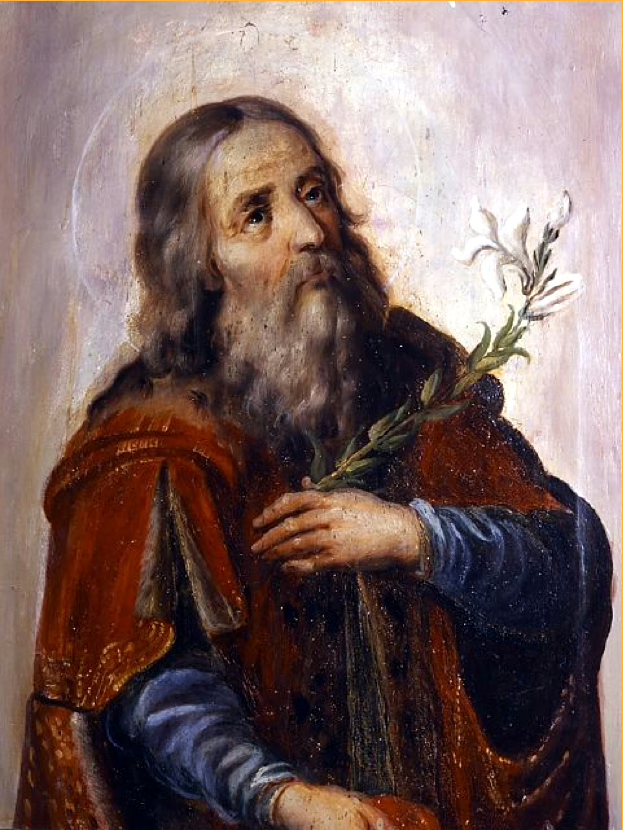
Saint John Henry Newman

Patron Saint of educators, converts, Oxford University, those seeking clarity in faith.
Feast Day: October 9th
Religious
London, England
Saint John Henry Newman
Public Domain: John Henry Newman, by Sir John Everett Millais, 1st Bt (died 1896) via Wikimedia Commons.
Feast Day: October 9th
Religious
London, England

About

Saint John Henry Newman (1801–1890) was a brilliant theologian, writer, and preacher who played a central role in both the Anglican and Catholic traditions. Born in London, he was ordained an Anglican priest and became one of the leaders of the Oxford Movement, which sought to revive the Catholic roots of the Church of England. After deep study and prayer, Newman converted to Catholicism in 1845, a decision that cost him friendships, reputation, and security. He was later ordained a Catholic priest, founded the Oratory of St. Philip Neri in Birmingham, and eventually was made a Cardinal by Pope Leo XIII. Newman was deeply devoted to education and the intellectual defense of the faith. His writings—such as Apologia Pro Vita Sua and The Idea of a University—addressed the relationship between faith and reason, the development of doctrine, and the call of conscience. His life was marked by humility, prayer, and service, and he was canonized as a saint by Pope Francis in 2019.

Legacy

Saint John Henry Newman is remembered as one of the most influential Catholic thinkers of the 19th century. His work continues to shape Catholic theology, especially in areas of conscience, education, and the development of doctrine. His emphasis on holiness in daily life and the importance of interior conversion resonates with Catholics today. Newman’s motto, “Cor ad cor loquitur” (Heart speaks to heart), reflects his belief that authentic faith is communicated through personal witness. He is especially revered by students, educators, and those seeking to reconcile faith with intellectual inquiry.
“God has created me to do Him some definite service. He has committed some work to me which He has not committed to another.” — Saint John Henry Newman

Links

Related Content